

Everything you need for a winter Spiti Valley trip in 2026–27: the Shimla–Kinnaur route, an 8-day itinerary, temperatures, cost, packing list and safety tips from our Trip Captains.
Quick answer: A winter Spiti Valley trip runs from December to February via the Shimla–Kinnaur route, because the Manali side (Atal Tunnel–Kunzum Pass) is closed by snow. Plan 7 to 9 days from Delhi or Chandigarh, expect night temperatures of −10°C to −25°C, and stay in heated homestays. The highlights are Key Monastery under snow, the frozen Spiti river, Langza, Hikkim, Komic and the chance to spot snow leopard tracks near Kibber.
Most people see Spiti in summer, when the roads are open and the valley is brown and gold. Winter Spiti is a completely different place. The river freezes into blue sheets of ice, the mountains turn white, the villages go quiet, and you understand why the people here call this the real Spiti.
It is also one of the toughest trips you can do in India. We say this upfront because we have taken groups to winter Spiti for years, and the people who enjoy it most are the ones who knew what they were getting into. This guide covers the route, the best time, a day-wise plan, the cost, what to pack and how to stay safe.
Is winter Spiti worth it?
Yes, if you are ready for the cold. Winter Spiti gives you landscapes that very few travellers ever see, almost no crowds, and a real look at how people live in one of the highest inhabited valleys in the world. It is not worth it if you are looking for comfort, fast internet or a relaxed holiday. Think of it as an expedition, not a vacation.

Best time for a winter Spiti trip
Month | What to expect | Good for |
|---|---|---|
Late November – December | First snowfall, rivers start freezing, roads mostly open | First-timers who want snow without peak cold |
January | Coldest month, deep snow, frozen river, nights can drop below −20°C | Hardcore winter lovers and photographers |
February | Still very cold, heavy snow possible, slightly longer days | Snow leopard season, quieter roads |
March | Snow starts melting, roads can be slushy | Shoulder season, fewer road closures |
If this is your first winter trip to the mountains, December is the sweet spot. You get snow and the frozen-river views, but the cold is a little more manageable than in January.
How to reach Spiti in winter
In winter, there is only one way in: the Shimla–Kinnaur route along the Sutlej. The Manali side, over Rohtang and Kunzum Pass, stays closed from around November to May because of snow. The winter route goes Shimla → Narkanda → Rampur → Reckong Peo/Kalpa → Nako → Tabo → Kaza.
From Indore or Bhopal, the easiest plan is an overnight train or flight to Delhi or Chandigarh, then the group vehicle onwards. Driving yourself is not a good idea unless you have serious experience on snow and ice. Roads beyond Kalpa can close for a day or two after heavy snowfall, so every good winter itinerary keeps a buffer day.
The route passes through Kinnaur, which is beautiful in its own right. Read our Kinnaur travel guide and the Chitkul travel guide if you want to add a stop.
8-day winter Spiti itinerary
Day 1: Delhi or Chandigarh to Shimla
The group meets in the morning and drives up to Shimla. It is a gentle first day to start acclimatising. Evening walk on the Ridge and Mall Road, dinner at the hotel. Overnight in Shimla. If you have extra time, our Shimla travel guide covers the town.
Day 2: Shimla to Kalpa
A long, scenic drive through Narkanda's apple country and along the Sutlej to Kalpa, with the Kinner Kailash range right in front of you. Breakfast and dinner included. Overnight in Kalpa.
Day 3: Kalpa to Nako to Tabo
The landscape changes completely after Kalpa. Green slopes turn into a rocky high-altitude desert. Stop at Nako village and its small frozen lake, then continue to Tabo, home to one of the oldest functioning monasteries in the Himalayas, founded more than a thousand years ago. Overnight in Tabo.
Day 4: Tabo to Dhankar to Kaza
Visit Dhankar Monastery, built dramatically on a cliff above the meeting point of the Spiti and Pin rivers. Then drive to Kaza, the main town of the valley at around 3,800 metres. Take it easy in the evening to acclimatise. Overnight in Kaza.
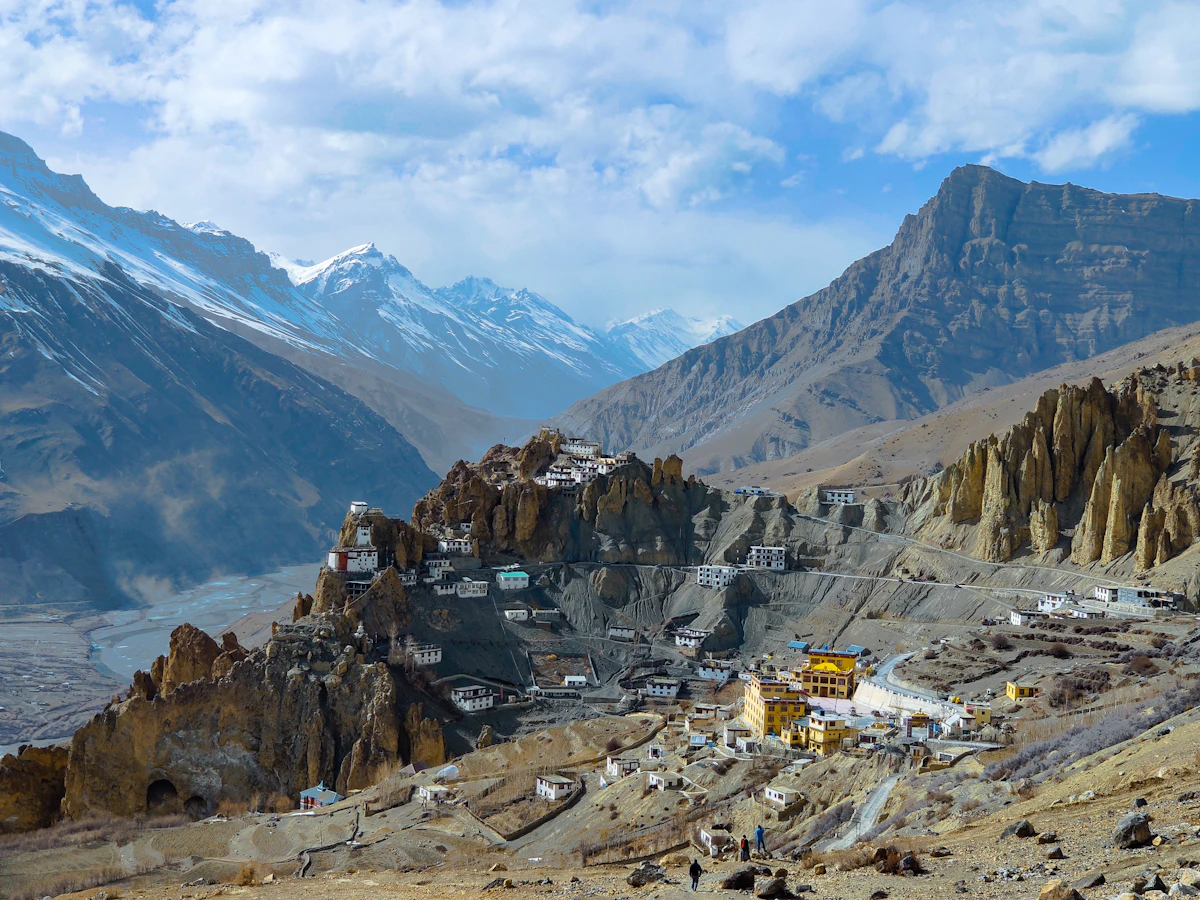
Day 5: Key Monastery, Kibber and Chicham
The day you have seen on Instagram. Key Monastery looks like it has been painted onto the hill, and in winter it is surrounded by white. Continue to Kibber, one of the best areas in India to look for snow leopards in winter, and the Chicham bridge over a deep gorge. Overnight in Kaza.
Day 6: Langza, Hikkim and Komic
The three high villages above Kaza. Langza has a giant Buddha statue facing the peaks and fossils in the surrounding hills. Hikkim is famous for one of the highest post offices in the world, so send a postcard home. Komic is among the highest villages in Asia connected by road. Overnight in Kaza.

Day 7: Kaza to Kalpa or Sangla
Start the return journey along the same route. This is also the buffer day if snow has closed a road earlier in the trip. Overnight in Kalpa or Sangla.
Day 8: Back to Shimla and onward
Drive back to Shimla and continue to Chandigarh or Delhi for your train or flight home.
Things to do in Spiti in winter
Walk on the frozen Spiti river near Kaza, only where locals and your Trip Captain say the ice is safe.
Join a morning prayer at Key Monastery and share butter tea with the monks.
Look for snow leopard and ibex on a guided wildlife walk around Kibber.
Hunt for fossils in the hills around Langza, which was once under the ancient Tethys Sea.
Post a letter from Hikkim's high-altitude post office.
Stay in a village homestay and learn how Spitian families prepare for months of snow, from dried vegetables to thukpa around the stove.
Shoot the night sky. With almost no light pollution, Spiti's winter skies are among the clearest in India for star photography.
Winter days are short, with the sun setting before 5:30 pm, so most activities happen between 9 am and 4 pm. Evenings are for the bukhari, card games and long conversations with your group.
How cold is Spiti in winter?
Very cold. Day temperatures in Kaza in January are usually around −5°C to 0°C, and nights can drop to −15°C to −25°C. Pipes freeze, so many homestays use buckets of warm water instead of running taps. Rooms are heated with a traditional bukhari stove. The cold is manageable with the right layers, but you should not underestimate it.
Winter Spiti trip cost
A winter Spiti group trip costs about ₹17,000 to ₹25,000 per person from Delhi or Chandigarh, including transport, stays and most meals. Our Winter Wonders of Spiti Valley trip starts from ₹17,499 per person. Add train or flight tickets from Indore or Bhopal, plus around ₹3,000 to ₹5,000 for personal expenses and warm gear if you do not already own it.
What to pack for winter Spiti
Base layers: 2 to 3 sets of good thermal inners.
Mid layers: fleece jacket or a thick sweater.
Outer layer: a down or heavy padded jacket rated for sub-zero temperatures.
Waterproof snow boots with good grip, plus woollen socks.
Gloves, woollen cap, neck warmer and sunglasses for snow glare.
Lip balm, heavy moisturiser and sunscreen.
Medicines: your regular medicines plus basics for cold, headache and altitude, after checking with your doctor.
Power bank and cash. Power cuts happen, ATMs are few, and UPI does not always work.
Safety tips for a winter Spiti trip
Acclimatise slowly. Spend your first night in Kaza resting and drink plenty of water. Headache, nausea or breathlessness are signs to slow down and tell your Trip Captain.
Do not self-drive unless you are very experienced on black ice.
Keep a buffer day. Snowfall can close roads without warning.
Expect limited network. Only some networks work in the valley, and data is slow. Tell your family before you go.
Respect the villages. Ask before photographing people and monasteries, and avoid single-use plastic.
Winter Spiti vs summer Spiti
Winter (Dec–Feb) | Summer (Jun–Sep) | |
|---|---|---|
Route | Shimla–Kinnaur only | Full circuit via Manali and Kunzum |
Chandratal Lake | Closed | Open |
Landscape | Snow, frozen river | Brown, gold, clear blue skies |
Crowds | Very few | Busy in peak months |
Difficulty | High | Moderate |
If you want Chandratal and the full loop, plan for summer with our Spiti with Chandratal full circuit trip instead.
Is winter Spiti safe for girls and first-timers?
Winter Spiti is safe for women and first-timers when you travel with an experienced group. The challenge is the cold and the altitude, not people. Spiti's villages are some of the friendliest places we take groups to. On TravelTech trips, girls share rooms only with girls, the Trip Captain carries basic medical supplies and checks on everyone daily, and our ground team tracks road conditions. Read a real group's experience in Spiti Valley adventure with strangers.
Plan your winter Spiti trip with TravelTech
TravelTech has taken more than 25,000 travellers across India over 8+ years and is rated 4.7★ on Google. Our winter Spiti trips run with an experienced Trip Captain, verified heated homestays and 24x7 support. You can book with a 50% advance and pay the rest before departure.
New to group travel? Read our strangers trip guide, or compare other cold-weather options in the best places to visit in December in India. For the bigger picture of the state, see our Himachal Pradesh travel guide.
✈️ Related Trips from TravelTech
Spiti Valley, Himachal Pradesh
Winter Wonders of Spiti Valley
From ₹17,499/-
per person

Spiti Valley, Himachal Pradesh
Spiti with Chandratal – Full Circuit
From ₹19,499/-
per person
Himachal Pradesh
Himachal Backpacking – Dharamshala, Bir, Manali & Kasol
From ₹10,999/-
per person
Manali, Kasol & Lahaul, Himachal Pradesh
Himachal New Year Special – Manali, Kasol & Lahaul
From ₹8,999/-
per person
728 × 90 — Leaderboard
❓ Frequently Asked Questions
Can you visit Spiti Valley in winter?
What is the best month for a winter Spiti trip?
How cold is Spiti Valley in January?
How many days are needed for a winter Spiti trip?
How much does a winter Spiti trip cost?
Is Chandratal open in winter?
Is winter Spiti safe for girls?
Does mobile network work in Spiti in winter?
Can I see a snow leopard in Spiti?
What should I pack for winter Spiti?
📚 Related Guides
More Travel Stories

Corporate Trip from Indore & Bhopal: 12 Best Offsite Ideas
Plan a corporate trip from Indore or Bhopal: best offsite destinations by duration, cost per person, team-building activities and a checklist.
Goa Trip from Indore: 5-Day Itinerary, Cost & Travel Guide
Plan a Goa trip from Indore: flights and trains, a 5-day North and South Goa itinerary, best time, real costs and tips for groups and first-timers.

Rishikesh Trip from Indore & Bhopal: 5-Day Itinerary & Cost
Plan a 5-day Rishikesh trip from Indore or Bhopal: river rafting, Ganga Aarti, Mussoorie and Haridwar, with rafting stretches, costs and tips.