
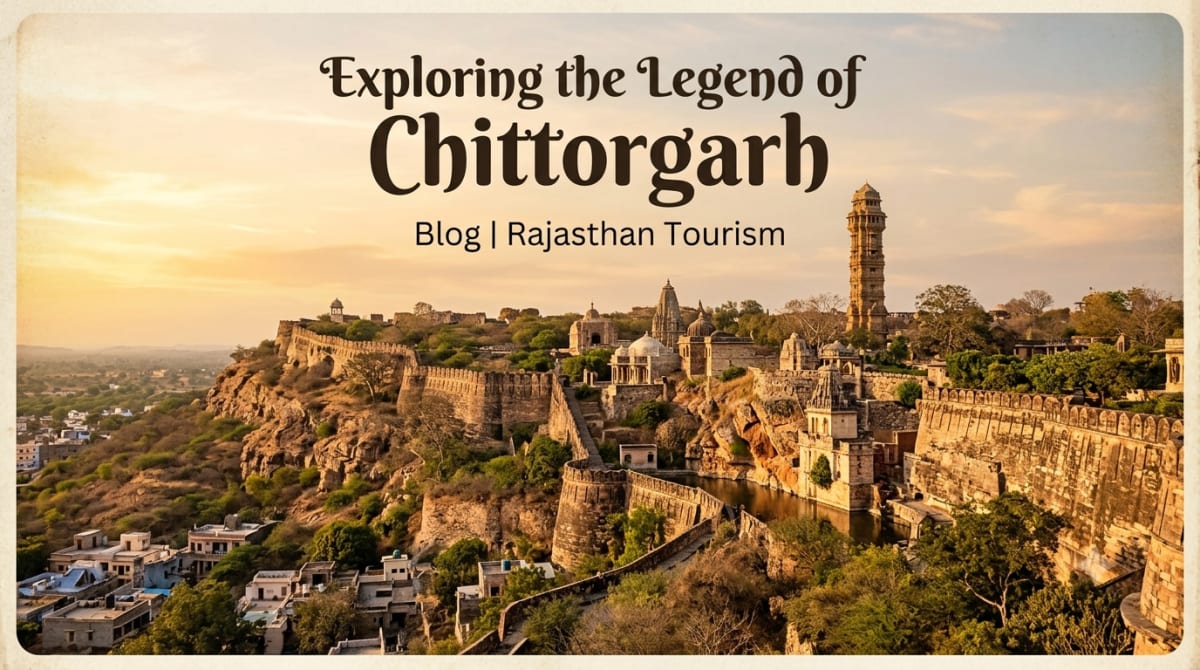
Chittorgarh Fort is one of Rajasthan’s most remarkable historical landmarks, known for its vast hilltop complex, three major sieges and the legacy of the Sisodia rulers of Mewar. A UNESCO World Heritage Site, it houses iconic monuments, ancient temples and historic towers that reflect the region’s rich and complex past. Exploring the fort takes time, and a planned route or local guide can help you understand its history and make the most of your visit.
Chittorgarh Fort: Rajasthan's Greatest Hill Fort, Its Three Sieges and What to See Inside
Some forts impress you with their walls. Others impress you with their size. Chittorgarh does both, and then adds something harder to describe: the feeling that you are walking through a place where history was not just made but argued over, mourned and remembered for centuries.
This is the former capital of the Sisodia rulers of Mewar. It is also the target of three of the most famous sieges in Rajasthan's history, the home of the towers and temples that appear on postcards across the state, and a UNESCO World Heritage Site. It is big enough that you will not finish it in an hour, and layered enough that it rewards a guide, or at least a good plan.
This guide explains the history in plain language, walks through the monuments in the order you are likely to meet them, and ends with a practical visitor section.
Quick facts
Where: Chittorgarh, southern Rajasthan, on a long hill rising from the plain.
Hill height: commonly given as about 180 m above the surrounding plain.
Area: around 280 hectares (roughly 700 acres), according to Wikipedia. Sources vary, so treat it as approximate.
Gates: seven main gateways (pols).
Status: a Monument of National Importance, and part of the UNESCO World Heritage Site Hill Forts of Rajasthan, inscribed in 2013.
Distance: roughly 119 km from Udaipur, about a two-hour drive.
Best time to visit: October to March.
Origins: a fort older than the Sisodias
Chittorgarh's story begins before the Sisodias. The fort was originally known as Chitrakut, and the early tradition credits it to a Mori ruler named Chitrangada. A later tradition says the Guhila ruler Bappa Rawal took the fort in the 8th century, around 728 or 734 CE, either from the Moris or, in another version of the legend, as a dowry.
Historians approach this carefully. The Bappa Rawal story is a legend, and the earliest Guhila inscription found at Chittor dates from the mid-13th century. The safe summary is that Chittorgarh was a fortified hill with ancient roots, which became the heart of Mewar and a major seat of the Guhila and Sisodia line. UNESCO describes it as a former capital of the Sisodia clan.
The three sieges of Chittorgarh
Chittorgarh's reputation rests on three great sieges. Each ended in tragedy, and each has become part of how Rajasthan remembers itself.
1303: Alauddin Khalji
The Delhi Sultan Alauddin Khalji besieged the fort for around eight months in 1303 and captured it. The poet Amir Khusrau, who recorded the campaign, reports a massacre of local people after the fall.
This siege is also linked to the legend of Rani Padmini, and here it is important to be careful. The story of Padmini and the mirror is popular and widely retold, but most modern historians treat it as a later literary legend rather than documented history. Some historians accept that a mass act of jauhar (self-immolation by women to avoid capture) took place in 1303, but they reject the Padmini narrative. As a traveller, you can enjoy the legend while remembering it is a legend.
1535: Bahadur Shah of Gujarat
In 1535, the Sultan of Gujarat, Bahadur Shah, attacked and sacked the fort. Tradition says that Rani Karnavati led thousands of women in jauhar while the men rode out to fight. The commonly repeated figures are about 13,000 women and 3,200 warriors, but treat the numbers as traditional estimates.
1567–68: Akbar
The third and last great siege was by the Mughal emperor Akbar. It lasted about four months. According to Wikipedia's account, the commander Jaimal was killed on 22 February 1568, and the next day the garrison fought its way out of the gates. A large number of civilians were killed afterward.
After 1568, the Sisodia capital moved, and Udaipur later became the centre of Mewar.
Why this history matters when you visit
You will hear jauhar and saka (the final charge of the men) used often around the fort. These words carry a lot of weight. The fort is remembered as a place of both pride and grief, so a respectful tone is part of visiting well.
Walking the fort: gates and ramparts
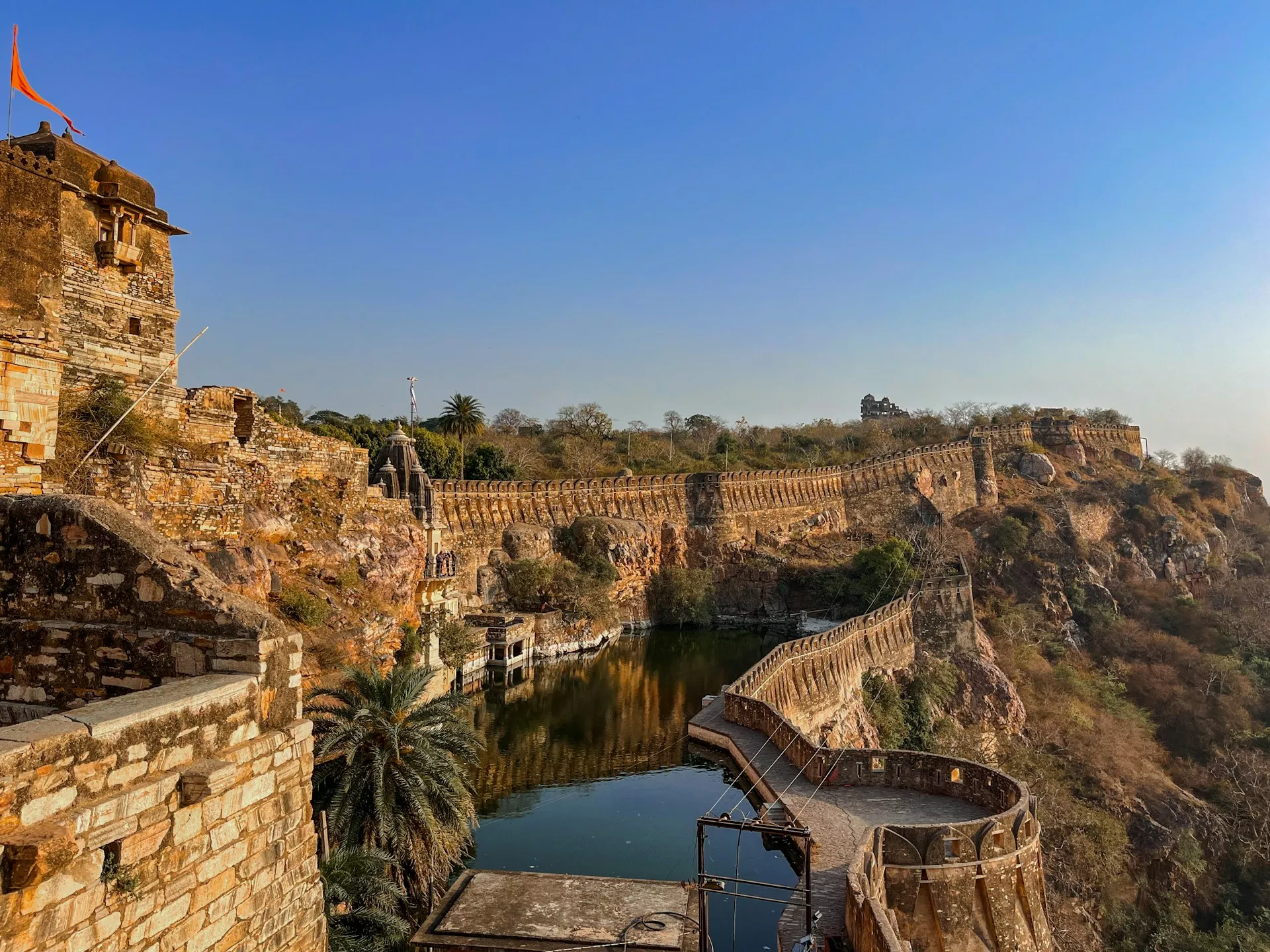
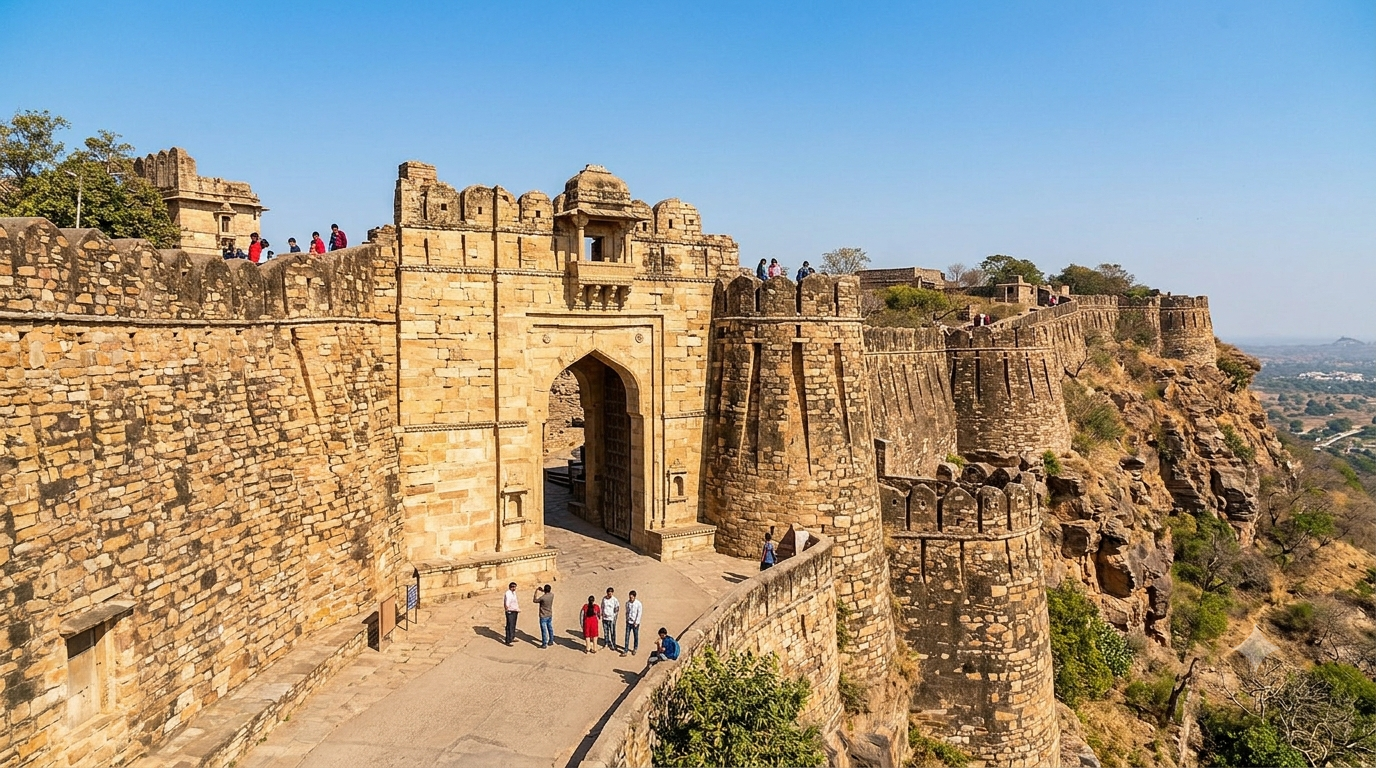
The approach to the fort is a climb through a series of gates, a classic defensive layout for a hill fort.
Sources list seven gates, though the spellings and order differ. The names commonly given are Padan (or Paidal) Pol, Bhairon Pol, Hanuman Pol, Ganesh Pol, Jodla (Jorla) Pol, Laxman Pol and Ram Pol, with Ram Pol the final and main gate before the fort interior. Each has heavy doors and a defensive bend, so enemy forces had to approach in a narrow, controlled way.
The walls are built of dressed stone in lime mortar, with rounded bastions along the ramparts. Published sources give different lengths for the walls, so it is best not to quote a single figure.
The main monuments inside Chittorgarh Fort
Vijay Stambh (Tower of Victory)
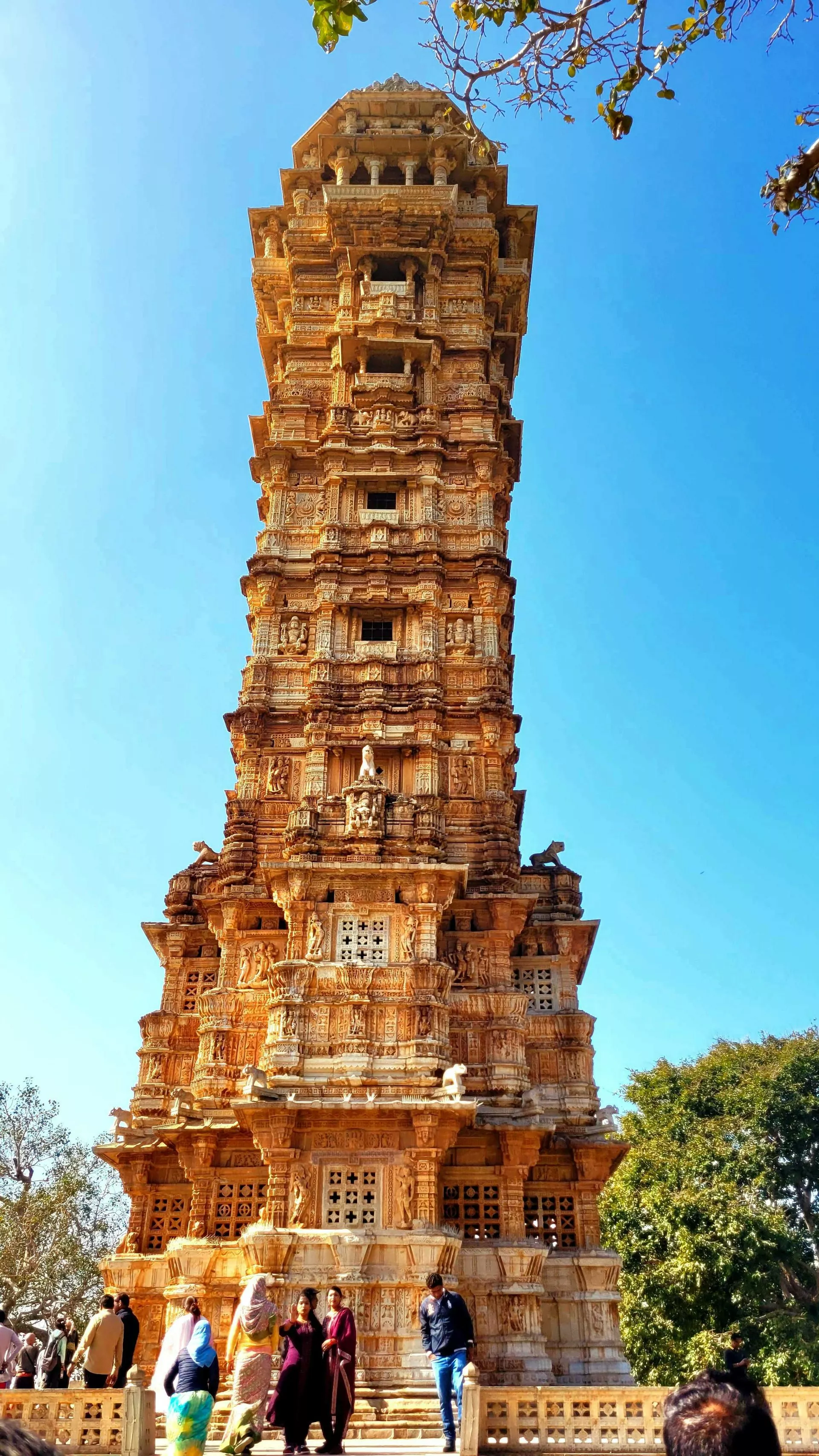
This is the monument most people picture when they think of Chittorgarh. Rana Kumbha built it between 1458 and 1468 to mark his victory over Mahmud Khalji of Malwa, a battle commonly dated to 1440.
Wikipedia gives its height as about 37 metres, with nine storeys and 157 steps inside. Some tourism sources describe it as eight storeys or about 122 feet, so you will see small differences across the internet. The dome was a later addition, damaged by lightning and repaired in the 19th century.
The tower is covered with carved figures of Hindu deities and decorative panels. Check locally whether you can climb it, because access rules at monuments change.
Kirti Stambh (Tower of Fame)
Smaller than the Vijay Stambh but older, this tower is about 22 metres (roughly 72 feet) tall. It is a Jain monument dedicated to Adinath, the first Tirthankara, and is probably from the 12th century, with a 15th-century pavilion added at the top. It is a useful reminder that Chittorgarh was a Jain as well as a Rajput centre.
Rana Kumbha Palace
The ruined palace of Rana Kumbha is one of the older royal buildings in the fort. It is associated in tradition with the birth of Udai Singh (founder of Udaipur) and with the poet-saint Mirabai, and it has a Shiva temple nearby. Much of it is in ruin, but the scale of the remains gives a sense of the original palace.
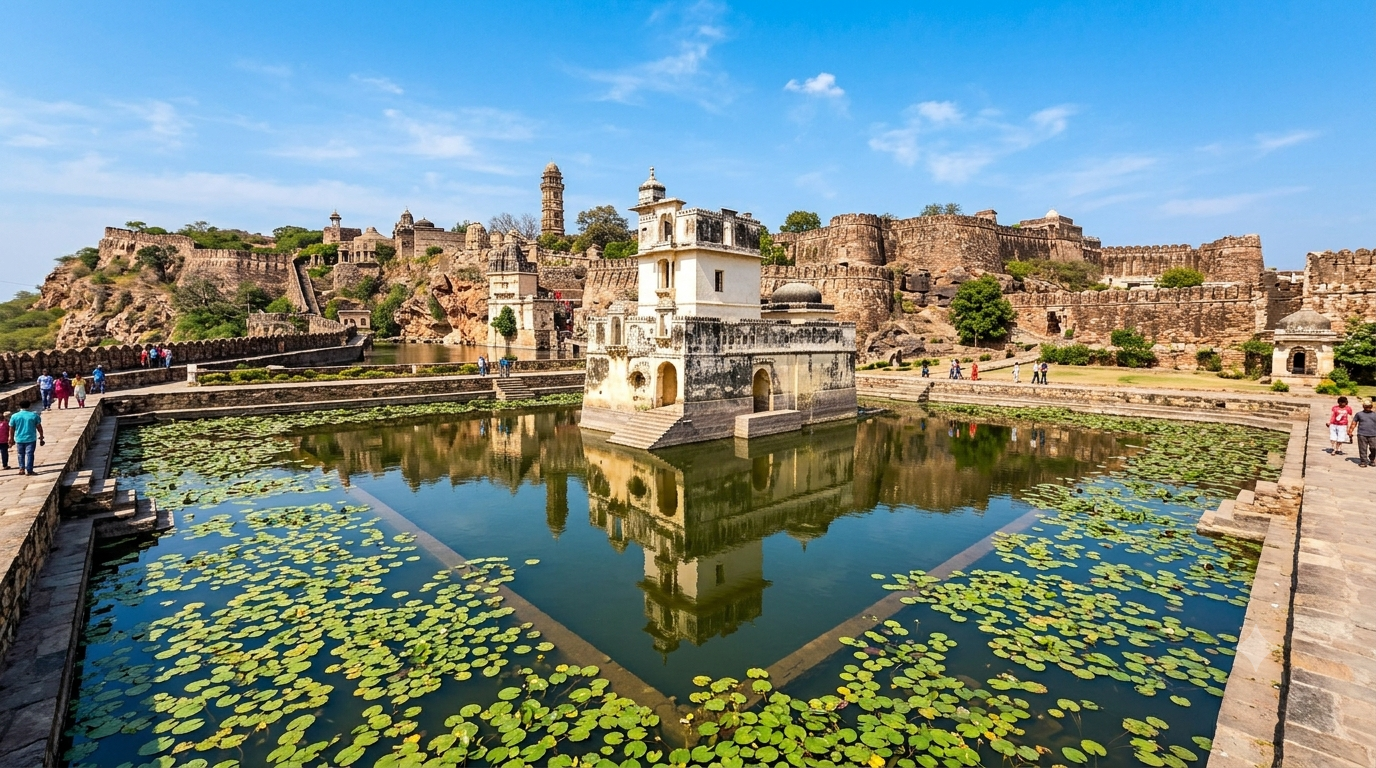
Padmini Palace
A white three-storey building surrounded by a water moat in the southern part of the fort. Tradition links it to Rani Padmini. Wikipedia describes the present building as a 19th-century reconstruction, so the structure you see is not the original from the legend.
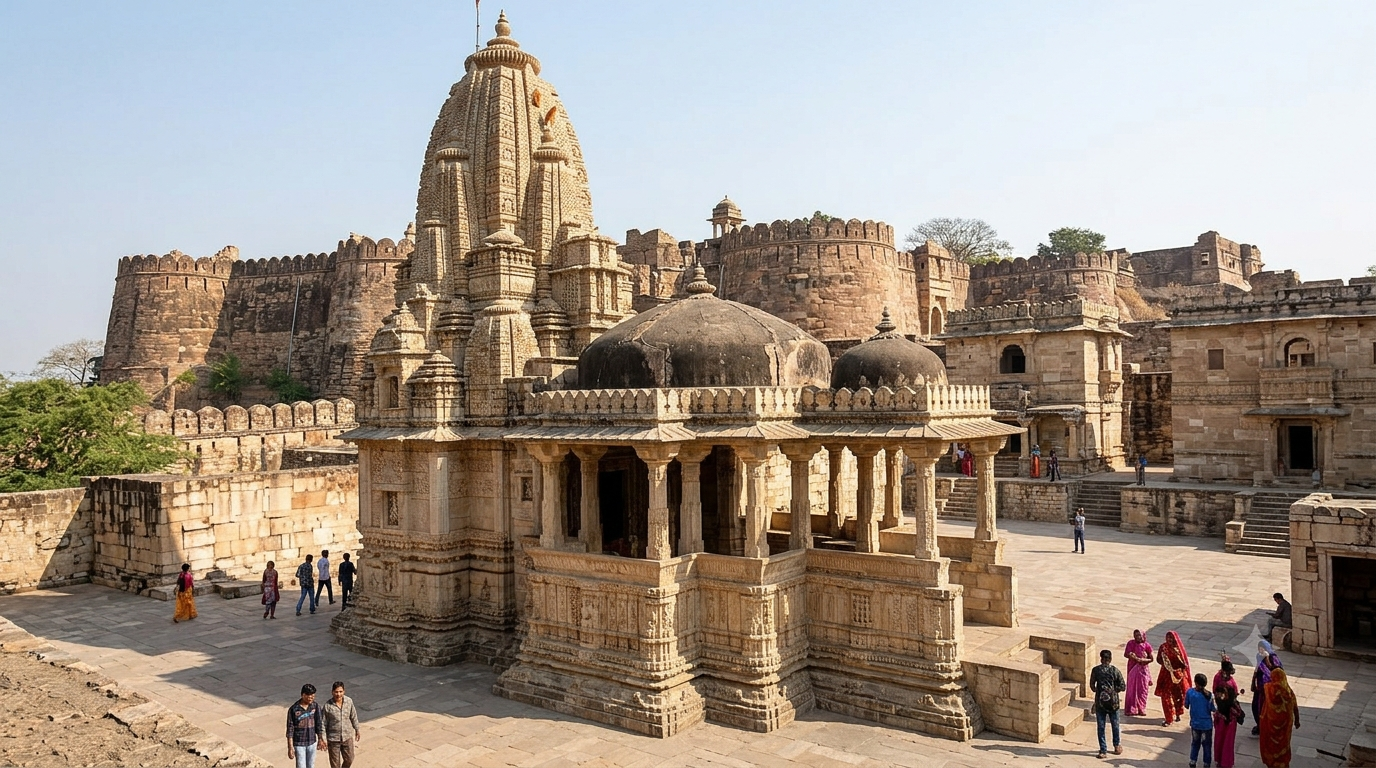
Meera Temple and Kumbha Shyam Temple
The Kumbha Shyam Temple, also called the Varaha temple, was built in 1448 by Rana Kumbha and has carved panels showing aspects of 15th-century Mewar life. The nearby Meera Temple is associated with Mirabai, the devotee-poet who is remembered for her songs of devotion to Krishna.
Kalika Mata Temple
This temple is believed to have started as an 8th-century sun temple dedicated to Surya. After being damaged in the 14th century, it was rebuilt and rededicated to the goddess Kali. It is a good example of how temples at the fort changed over time.
Gaumukh Kund and the Samidheshvara temple
At the edge of the hill is a reservoir fed by a spring that flows through a carved cow's mouth (gaumukh) in the rock. Sources describe it as an important water source during sieges. It sits close to the Samidheshvara (often spelled Samadhishwar) temple, and visitors often feed the fish.
Fateh Prakash Palace and its museum
A later palace built in the late 19th and early 20th century, now with a museum. The museum is listed as open slightly shorter hours than the fort.
Water: the secret of surviving a siege
A fort can have the thickest walls and still fall if it runs out of water. Wikipedia says Chittorgarh once had about 84 water bodies, of which about 20 to 22 survive today. The page also says total storage was around 4 billion litres, enough for an army of 50,000 for up to four years, though that is a historical estimate rather than a measured fact.
UNESCO notes that the Hill Forts of Rajasthan as a group have extensive water-harvesting structures, many still in use. If you see the stepwells, tanks and reservoirs on the plateau, you are seeing the infrastructure that made long sieges possible.
Why Chittorgarh is a UNESCO World Heritage Site
Chittorgarh was inscribed in 2013 as part of the Hill Forts of Rajasthan, together with Kumbhalgarh, Ranthambore, Gagron, Amer and Jaisalmer. UNESCO recognises the fort for its role as an expression of Rajput princely power and for its architecture, which includes early remains dating from the 8th to 16th centuries. UNESCO's evaluation also flagged concerns, including nearby quarrying and industrial activity affecting the fort's setting, and structures in decay.
Visiting Chittorgarh Fort: practical guide
Check before you go: Websites list different timings and ticket prices. The details below are from published sources, and you should confirm them at the counter.
Timings
One tourism listing gives the fort's hours as 9:45 AM to 6:30 PM, and the Fateh Prakash Palace Museum as 9:45 AM to 5:15 PM, with both closed on Mondays and some festivals. Another source lists 9 AM to 6 PM. Confirm on the day, especially the Monday closure for the museum.
Tickets
Reported entry fees for the fort are ₹40 for Indian visitors and ₹600 for foreign visitors, though some listings show lower older figures (₹10 and ₹100). The museum has a separate, small ticket.
Light and sound show
An evening show at dusk, in Hindi and English, is mentioned by several sources. Prices and the language schedule vary by source, so check at the fort.
Tips
Start early so you can cover the far side of the plateau before it gets hot.
Wear comfortable shoes with good grip.
Carry water and sun protection.
Hire a licensed guide if you want to understand the sieges and legends properly.
Be respectful at temples and memorials.
Combine Chittorgarh with Kumbhalgarh and Ranakpur
Chittorgarh and Kumbhalgarh are two of the six Hill Forts of Rajasthan, and both were closely tied to Rana Kumbha. Read our guides to Kumbhalgarh Fort and Ranakpur Jain Temple to see how the three places fit together in the story of 15th-century Mewar. For a fuller route, see our Rajasthan group trips.
🗓️ Best Time to Visit
October to March
Best for visit
when the weather is mild. Summers are very hot and the fort offers little shade.
🚗 How to Reach
By road
about 119 km from Udaipur (roughly two hours). Bundi is around three hours away.
By train
Chittorgarh has its own railway station, and many visitors arrive by rail.
Within the fort
the area is large, so most visitors hire a vehicle, an auto-rickshaw or a guide to cover the plateau. Walking all of it in one go is tiring.
728 × 90 — Leaderboard
❓ Frequently Asked Questions
Who built Chittorgarh Fort?
What are the three sieges of Chittorgarh?
What is the Vijay Stambh?
Is the Padmini story true?
What are the Chittorgarh Fort timings and ticket price?
How far is Chittorgarh from Udaipur?
Is Chittorgarh a UNESCO World Heritage Site?
How much time do I need?
📚 Related Guides
More Travel Stories
Kumbhalgarh Fort: History, 7 Gates, Temples, Badal Mahal & Complete Visitor Guide
Kumbhalgarh Fort explained using ASI information boards: Rana Kumbha's history, seven gates, Neelkanth and Parsvanatha temples, Badal Mahal and visit tips.
Ranakpur Jain Temple: History, 1,444 Pillars, Architecture, Timings & Visitor Guide
Ranakpur Jain Temple explained: Dharna Shah's dream, Rana Kumbha's role, the 1,444 pillars, architecture, timings, dress code and how to plan your visit.

Dussehra 2026: How 11 Indian States Celebrate It, and Where to See
Dussehra 2026 falls on 20 October. See how Bengal, Gujarat, Kullu, Delhi, Mysuru, Bastar, Kota and more celebrate it, with dates and travel tips.