
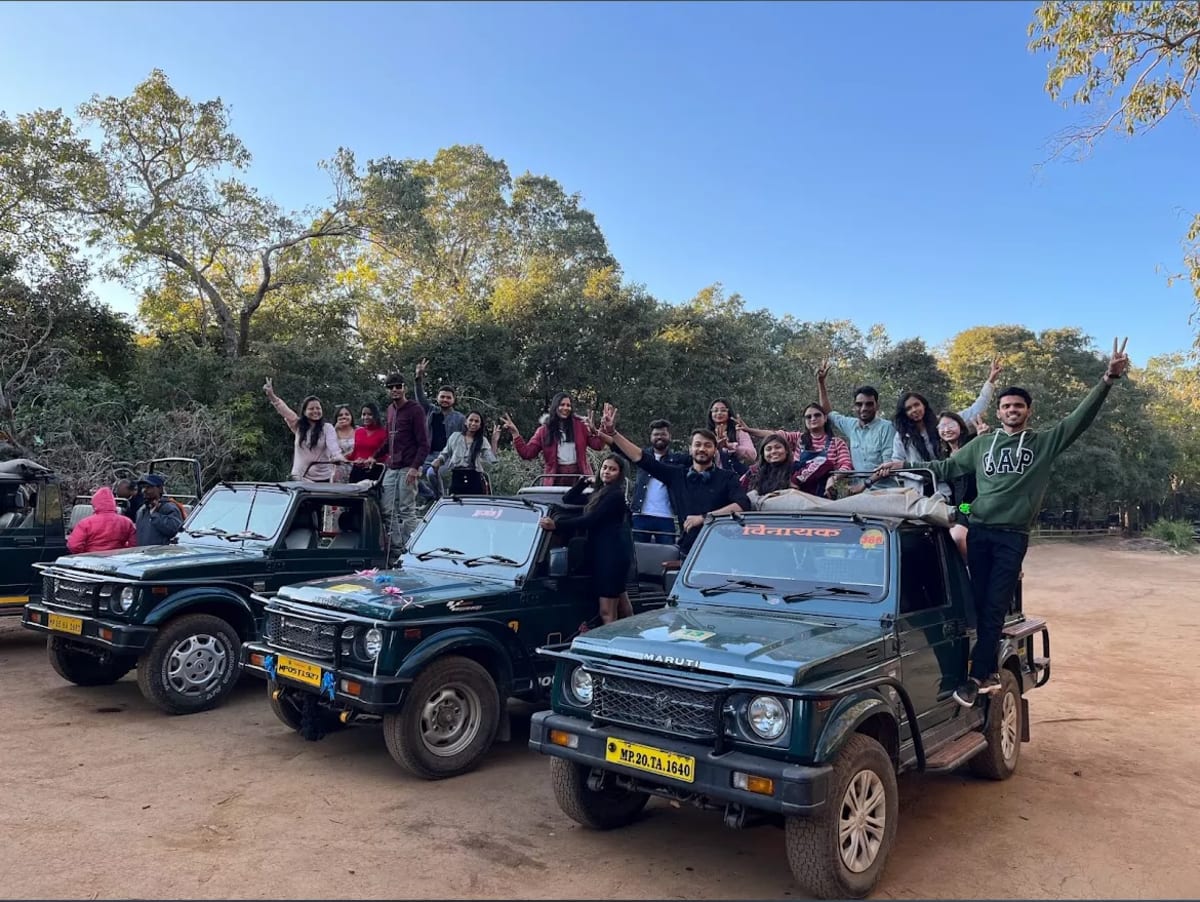
The Indore to Pachmarhi Stranger Trip: A Weekend That Turns Strangers Into Family
There's a particular kind of nervousness that comes with signing up for a trip where you don't know a single soul. I felt it on a Friday evening, bag packed, standing at the pickup point with nothing but a confirmation message that read: Pachmarhi Stranger Trip, by TravellTech.
By the time I returned to Indore on Monday morning, that nervousness had turned into something else entirely — a phone full of memories, a handful of new friends, and a deep appreciation for a hill station I'd somehow never explored despite living so close to it.
This is the complete story of that trip — the journey, the people, the legends behind every landmark, and why a weekend like this deserves a spot on your travel list. If you're planning to join one of these Friday-night-to-Monday-morning getaways from Indore, here's everything you can expect, told exactly as it happened.
Friday Night: Leaving Indore Behind
Around 9:30 PM, people began trickling into the pickup point — some alone like me, some in pairs, but all carrying the same mix of curiosity and slight apprehension. The trip captain greeted everyone, ran a quick round of introductions, and within minutes of boarding the bus, it was clear this wasn't going to be an awkward, silent ride.
The captain kicked off a few icebreaker games almost immediately — a mix of antakshari, light dares, and quick-fire questions. By the two-hour mark, the bus that had been full of strangers was already buzzing with laughter.
Somewhere past Dewas, we stopped at a roadside dhaba for breakfast — hot parathas, steaming chai, and a much-needed stretch. It's funny how a shared plate of food at 2 AM can do more for bonding than hours of conversation. By the time we got back on the bus, a few of us had already become unofficial "trip buddies."
Bhopal: A Quick Stop With a Lot of History
Early morning, we rolled into Bhopal, where a few more travelers joined the group — people who preferred boarding directly from the city. We had a short window here, enough to catch a glimpse of Bhopal's old fort area, a reminder of the city's layered past shaped first by the Gond rulers and later the Nawabs of Bhopal. Often called the "City of Lakes," Bhopal in the early morning mist, with its lakes shimmering quietly, has a charm that's easy to miss if you're only passing through — which made this brief stop feel like a nice teaser for a future trip.
From here, the bus pushed on toward our next major stop: Pipariya.
Pipariya: Where Every Route Converges
We reached Pipariya around 7 AM. This town plays a quietly important role in the itinerary — it's the nearest railhead to Pachmarhi and sits right on the Mumbai-Kolkata railway line. That makes it the perfect joining point for travelers coming in from Jabalpur, Nagpur, Delhi, or pretty much anywhere else in the country. A few more group members hopped on here, and by this point, the trip had grown into a proper crew — different cities, different backgrounds, one shared mission: explore Pachmarhi.
Arriving at the Resort: Pool Party and the First Breakfast
The drive from Pipariya to the resort was a visual treat — dense forest on both sides and a noticeable drop in temperature as we climbed higher. The moment we arrived, everyone headed straight for the pool party. Music was on, a rain dance session was already underway, and people who hadn't known each other's names twelve hours earlier were now singing together with their arms around each other's shoulders.
Breakfast, provided by TravellTech, followed soon after — a full Indian-style spread that hit the spot after a long night of travel. A short rest period gave everyone a chance to recharge before the day's sightseeing began.
Day 1 Sightseeing: Mythology, Forests, and Adventure
After resting, we set off in open gypsies for the day's exploration. True to form, the trip captain kept the energy alive throughout — antakshari, "two truths and a lie," and impromptu photo challenges filled the gaps between stops.
Gupt Mahadev and Bada Mahadev
Our first stop was Gupt Mahadev, a temple tucked into a narrow gap between two massive rock formations, so closely positioned that the cave between them is barely a few feet wide. The Shivling inside sits in near darkness, lit only by whatever sunlight slips through the crack above — which is exactly why it's called "Gupt" (hidden).
A short distance away is Bada Mahadev, which also serves as the base point for one of Pachmarhi's most significant treks — Chauragarh.
The Legend and History of Chauragarh
Listening to the story behind Chauragarh was the moment I realized Pachmarhi isn't just about scenery — it carries centuries of mythology woven into its hills.
According to legend, the demon Bhasmasura once received a boon from Lord Shiva — the power to turn anyone to ash simply by placing his hand on their head. True to demonic nature, Bhasmasura decided to test this power on Shiva himself. Shiva fled, and in his escape through the Satpura hills, he is said to have taken refuge in several spots — eventually shedding parts of himself at different points, each of which later became a sacred site.
A second, equally popular legend tells of Chora Baba, an ascetic who meditated on this hill for years. Pleased with his devotion, Shiva appeared before him, declared that the hill would henceforth be known as Chauragarh, and left his trident (trishul) behind as a blessing. This is believed to be the origin of a tradition that continues today — devotees who have their wishes fulfilled return to offer a trishul at the temple. As a result, the temple grounds are now covered with thousands of trishuls, some small, others weighing well over 150 kg.
Reaching the temple requires climbing roughly 1,300 stone steps through dense forest, past cascading mountain streams, to an altitude of 1,330 meters — making it the third-highest point in the Satpura range. During Mahashivratri, the temple draws lakhs of devotees, many of whom carry massive trishuls up the entire climb as an act of devotion. Our group didn't have time for the full trek that day, but even standing at the base and watching the path disappear into the forest was enough to put Chauragarh firmly on my list for a future visit.
Green Valley, Priyadarshini Point, and Handi Khoh
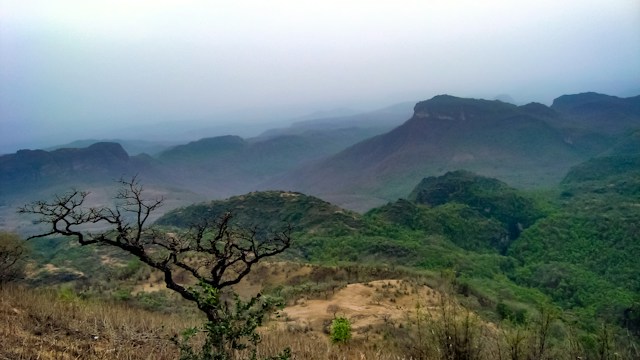
Next came Green Valley — and the name doesn't oversell it. Rolling hills stretch out in every direction, often wrapped in a thin layer of mist that makes the whole landscape look almost painted.
From there, we moved to Priyadarshini Point, also known as Forsyth Point. This spot holds a special place in Pachmarhi's history — it's where Captain James Forsyth, a British army officer, first spotted the Pachmarhi plateau in 1857 while en route to Jhansi. That sighting eventually led to the founding of Pachmarhi as a hill station and summer retreat for British troops stationed in the Central Provinces. Standing there today, looking out over the same valley Forsyth once saw, gives the view an extra layer of meaning.
Our next stop was Handi Khoh, a dramatic 300-foot-deep gorge framed by sheer cliffs and dense forest. Local legend says the gorge was once a lake that dried up under the force of Lord Shiva's power. The real highlight, though, is the echo — shout into the gorge, and the forest answers back, a moment that turned the whole group quiet for a second before everyone burst out laughing and tried it again.
Pachmarhi Lake: Where Adventure Took Over
By midday, we arrived at Pachmarhi Lake, and this is where the trip shifted into full adventure mode:
Zip-lining across the lake, with a clear view of the surrounding green hills below
Boating, a calmer but equally enjoyable way to take in the scenery
Horse riding along the lake's edge — the kind of moment that feels straight out of a film
A few zorbing and aerial-style rides, depending on what was running that day
By this point, the group dynamic had completely shifted. People who'd been strangers less than 24 hours earlier were now teasing each other, swapping playlists, and planning who'd sit next to whom on the way back.
Back to the Resort: Games, Bonfire, and Late-Night Conversations
As the sun started to dip, we headed back toward the resort, and the bus ride turned into its own little party — rounds of dumb charades, antakshari, and a general atmosphere of "this trip is too short" energy.
After dinner at the resort, the night's real highlight began — the bonfire. Sitting in a circle around the fire, with someone strumming a guitar, people started opening up. Some shared stories from their lives, others just sang along. It's a strange but wonderful thing — somewhere between the flames and the music, the usual social guard most of us carry just disappears. That's the real magic of a stranger trip: people stop performing and start being themselves.
Day 2: Early Mornings and the Mysterious Jatashankar
The trip captain had everyone up early the next morning — Day 2 is packed, and it's arguably the most historically rich day of the entire trip. After a quick breakfast, we set out in open gypsies to cover the day's circuit.
Jatashankar Temple
Our first stop was Jatashankar, a Shiva temple set inside a natural limestone cave, where naturally formed Shivlings sit nestled between massive boulders. According to legend, this is where Shiva hid while fleeing Bhasmasura and left behind his jata (matted hair) — giving the place its name. A small underground stream runs through the cave, believed by devotees to be connected to the sacred river Ganga. The cool, damp interior of the cave creates an atmosphere unlike anywhere else on the trip.
Bee Falls (Jamuna Prapat)
Next was Bee Falls, also known as Jamuna Prapat. The name comes from the buzzing sound the waterfall makes from a distance, reminiscent of a swarm of bees — fitting, since the area is also known for its honeybee population. What's genuinely interesting is that this waterfall serves as the primary drinking water source for the entire town of Pachmarhi. There's a natural pool here where visitors can take a dip, and in some sections, small "doctor fish" nibble at dead skin — an unexpected, completely natural spa experience.
Pandav Caves
From there, we reached Pandav Caves, the site that actually gave Pachmarhi its name. The word "Pachmarhi" comes from the Hindi words "Panch" (five) and "Marhi" (caves) — literally, "the place of five caves."
Local legend holds that the five Pandava brothers from the Mahabharata took shelter here during their thirteen years of exile, with five caves built for the brothers and a sixth, more spacious one for their wife, Draupadi.
The historical record tells a slightly different story. Archaeologists date the caves to somewhere between the 10th and 12th century, possibly even earlier, and attribute their construction to Buddhist monks, who likely carved them as meditation spaces, with some accounts linking them to the era of Emperor Ashoka. A small stupa-like structure found at the top supports this theory. Regardless of which version you lean toward, the caves remain one of Pachmarhi's most visited and atmospheric sites.
Bison Lodge
Next on the route was Bison Lodge, the oldest building in Pachmarhi, constructed in 1862 by Captain James Forsyth (some records credit Sir Richard Temple around 1870). Originally used as a military outpost, it now functions as an eco-museum showcasing the biodiversity and wildlife of the Satpura region, complete with life-sized animal models. It's also the starting point for forest safaris and guided nature walks, and where visitors can obtain the required day-permit for sightseeing in the region.
Reechgarh
We then made our way to Reechgarh, a quieter, less crowded spot named after "reech" (bear), since the area was historically home to bears. Surrounded by thick forest and offering peaceful valley views, it's an ideal stop for travelers looking for a calmer moment away from the more popular tourist spots.
Dhoopgarh: The Highest Point in Madhya Pradesh
And then came the spot the entire day had been building toward — Dhoopgarh.
Dhoopgarh is the highest point in Madhya Pradesh, standing at an elevation of 1,352 meters (4,436 feet), and it's the tallest peak in the entire Satpura range. The name translates to "home of sunshine," and it was historically known as "Harvatsa Kot." Getting there involves a winding, slightly thrilling gypsy ride through dense Satpura forest, with the road curving sharply at several points.
We arrived just before sunset, and what followed is genuinely difficult to put into words. The sun begins its slow descent, and the entire sky shifts — gold first, then a deep orange, and finally a rich pink-red that spreads across the horizon. Below, the Satpura forest stretches out endlessly, with the distant glimmer of the Tawa reservoir and Denwa river catching the last light. On especially clear evenings, you can supposedly see the lights of Pachmarhi town and its lake far below once night falls, and the sky becomes so clear that counting stars feels like an impossible task.
The entire group fell quiet at the sight — no jokes, no chatter, just a shared moment of taking it all in. It was one of those rare instances where everyone simultaneously understood that some experiences matter more than the photos taken of them — though, of course, we still took plenty.
(This is a strong spot to feature your hero sunset photo on the website. A subtle dark gradient overlay at the bottom of the image will help any overlaid caption text stay readable against the bright sky.)
The Journey Back: Heading to Indore, Leaving a Piece of Us in Pachmarhi
After watching the sunset, we returned to the resort for dinner before boarding the bus back to Indore. The return journey was every bit as lively as the trip out — more jamming sessions, more antakshari, a few people drifting off to sleep, and the rest still running on pure trip energy.
What struck me most was how completely the word "stranger" had stopped applying. The same people who hadn't known each other's names on Friday night were now swapping life stories, dreams, and inside jokes — the kind of comfort that usually takes years to build.
We rolled into Indore around 7 AM on Monday, tired but unmistakably happy, with a phone full of photos and a weekend's worth of memories that felt much bigger than two days.
Why You Should Consider This Trip
If you're based in Indore and have ever hesitated to travel solo, worrying about how it would feel to spend a weekend surrounded by people you've never met — this trip is proof that it's one of the best decisions you can make for yourself.
TravellTech's Friday-night-to-Monday-morning Pachmarhi stranger trip is far more than a sightseeing tour. It's a complete experience — new friendships, centuries-old legends, genuine adventure, and a fresh perspective on yourself, all packed into one unforgettable weekend.
These trips run every Friday, led by experienced trip captains who know exactly how to turn a group of strangers into a tight-knit crew within hours. If you're looking to break your routine and try something different, this is one trip worth booking. Chances are, by the end of it, you'll be saying the exact same thing every traveler on this trip says: "These people don't feel like strangers anymore."
Ready to join the next Pachmarhi stranger trip? Connect with TravellTech to book your seat — some weekends are worth experiencing more than once.
🗓️ Best Time to Visit
Monsoon
Best for Nature lover
✈️ Related Trips from TravelTech
728 × 90 — Leaderboard
❓ Frequently Asked Questions
What is the best time to visit Pachmarhi for a group trip?
Is this Pachmarhi trip suitable for solo travellers or strangers?
What are the major attractions covered in this Pachmarhi tour package?
How difficult is the Chauragarh Mahadev trek?
What should I pack for Pachmarhi trip?
How is the network connectivity in Pachmarhi?
📚 Related Guides
More Travel Stories
Kumbhalgarh Fort: History, 7 Gates, Temples, Badal Mahal & Complete Visitor Guide
Kumbhalgarh Fort explained using ASI information boards: Rana Kumbha's history, seven gates, Neelkanth and Parsvanatha temples, Badal Mahal and visit tips.
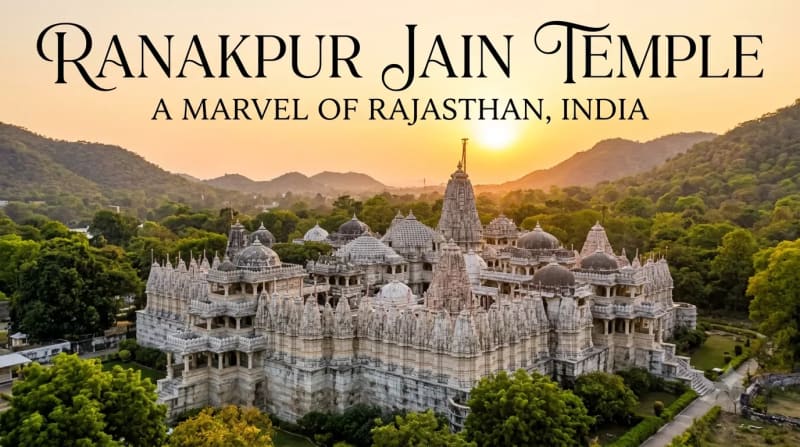
Ranakpur Jain Temple: History, 1,444 Pillars, Architecture, Timings & Visitor Guide
Ranakpur Jain Temple explained: Dharna Shah's dream, Rana Kumbha's role, the 1,444 pillars, architecture, timings, dress code and how to plan your visit.
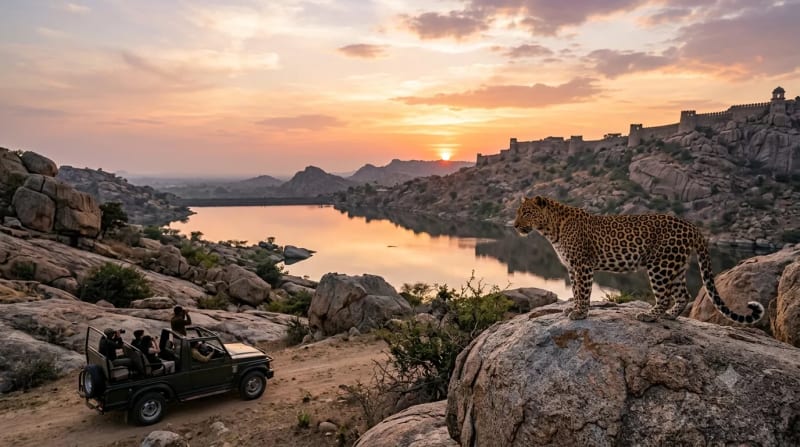
Jawai Stranger Trip from Indore: My Honest Experience
I joined a Jawai group trip from Indore as a solo traveller: Kumbhalgarh, Ranakpur, a leopard safari and strangers who became friends. Here's how it went.