
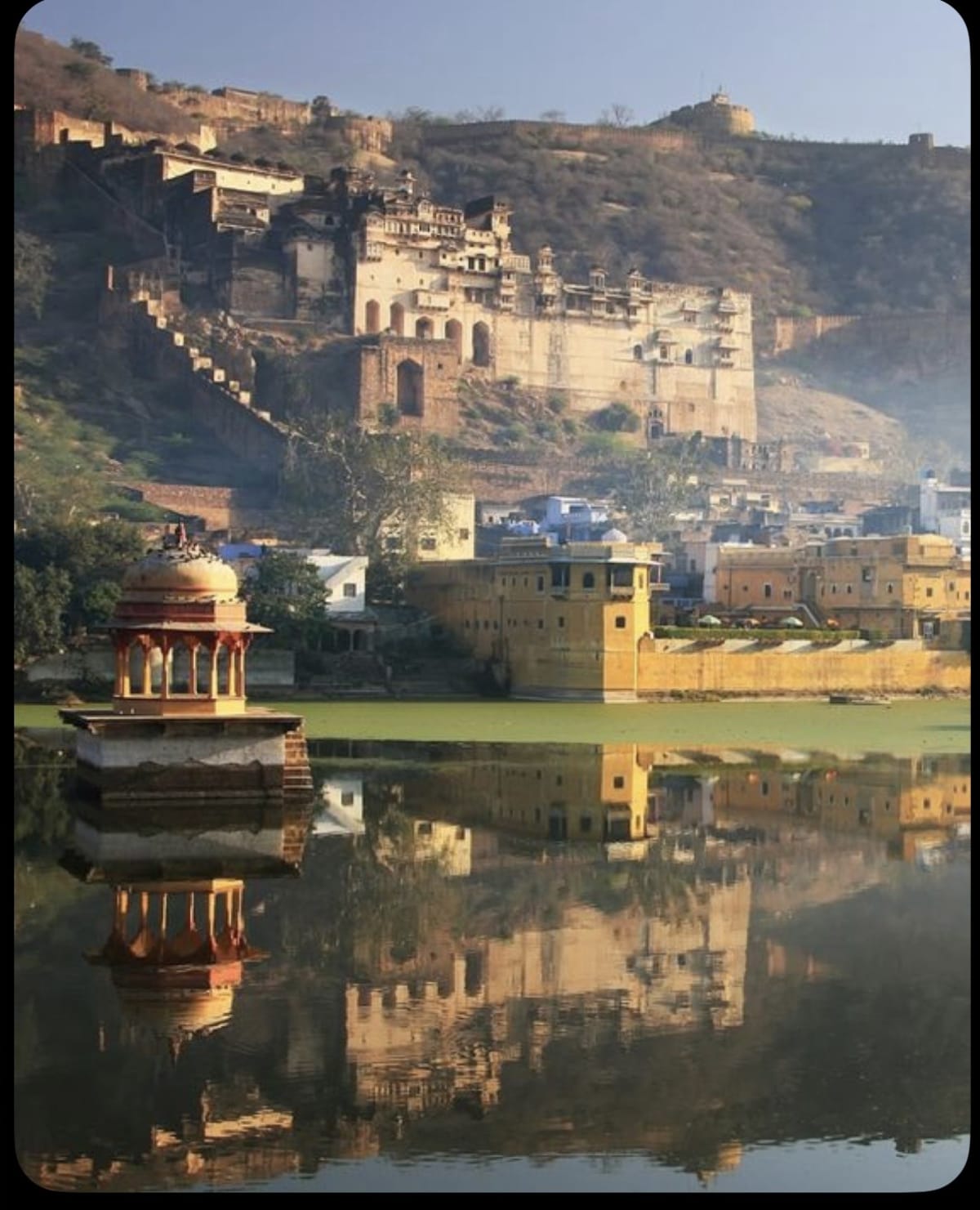
Explore Bundi, Rajasthan’s historic town of grand forts, intricate miniature paintings, ancient stepwells and peaceful lakes. Plan your visit with TravelTech’s practical travel guide.
Quick answer: Bundi is a small Hadoti town known for Taragarh Fort, the Garh Palace and its Chitrashala murals, Raniji ki Baori and other stepwells, Nawal Sagar and Jait Sagar lakes, Sukh Mahal and the 84 Pillared Cenotaph. One to two days is enough. The best time to visit is October to March, and Bundi is about 35–40 km from Kota, the nearest major railway junction, and around 210 km from Jaipur.
Rajasthan is famous for its royal cities, desert landscapes and imposing forts, but Bundi offers a different kind of historical charm. Here, the landscape rises into rocky hills, blue-toned houses line narrow streets, and centuries-old stepwells reveal how communities once managed water in a challenging climate.
The town developed under the Hada Chauhan rulers and became an important centre of the former Hadoti region. Its best-known landmarks include Taragarh Fort, Garh Palace, Chitrashala and Raniji ki Baori. Bundi is also celebrated for its miniature-painting tradition, whose detailed murals portray royal life, religious themes, nature and courtly scenes.
Bundi suits travellers who enjoy heritage, architecture, photography and relaxed cultural exploration. Rather than rushing between attractions, allow yourself time to appreciate the artwork, talk to local guides and explore the old town on foot.
The Soul of the Destination
Bundi’s personality comes from the relationship between its architecture, hills and water. The old town sits beneath the rugged slopes around Taragarh Fort, while Nawal Sagar Lake reflects the surrounding historic buildings. Blue-painted houses, carved doorways, narrow lanes and traditional havelis give the town a character that feels distinct from Rajasthan’s larger urban centres.
Its most remarkable feature may be the way water shaped its history. Stepwells and kunds were not merely decorative structures; they helped communities store water and also served as places for social and religious life. Raniji ki Baori, with its multi-storey design and carved pillars, is one of the clearest examples.
Bundi is also associated with a distinctive school of miniature painting. At Chitrashala, intricate murals and painted surfaces reveal the region’s artistic traditions. The experience is less about grand modern attractions and more about noticing the details: a painted ceiling, a carved elephant, a shaded courtyard or a view over the rooftops.
What makes Bundi different? It combines forts, palace art, stepwells and a relatively unhurried small-town atmosphere. However, some heritage structures show signs of age, so visitors should not expect every corner to be fully restored or museum-like.
Best Time to Visit Bundi
The most comfortable months for sightseeing are generally October to March, when daytime temperatures are more suitable for walking around forts, stepwells and the old town. Rajasthan’s official tourism information also highlights Bundi’s cultural events during the cooler part of the year.
Places to Visit in Bundi
Bundi’s main attractions are spread between the old city, the surrounding hills and nearby countryside. Entry fees and opening arrangements can change; where current official details could not be verified, confirm locally rather than relying on an old online listing.
1. Taragarh Fort
Allow 1.5–2.5 hours
Built in 1354 according to Rajasthan Tourism, Taragarh Fort overlooks Bundi from a hill and is one of the town’s defining landmarks. Its historic walls, gateways and elevated views make it especially rewarding for travellers interested in architecture and photography.
Practical tip: The approach can be steep and uneven. Wear grippy footwear, carry water and avoid the hottest part of the day. Check access conditions locally before setting out.
2. Garh Palace (Bundi Palace)
Allow 1.5–2 hours
This palace complex grew over several generations of Bundi rulers. Look for its gateways, balconies, carved details and historic rooms. It is an essential stop for understanding the town’s royal architecture.
Practical tip: Palace access and the condition of individual sections can vary. Confirm current opening hours, ticket prices and whether specific areas are open before visiting.
3. Chitrashala
Allow 30–60 minutes
Chitrashala, within the palace complex, is one of Bundi’s most celebrated artistic spaces. Its miniature-style murals depict themes from courtly life, mythology and nature, showcasing the region’s distinctive painting tradition.
Best for: Art lovers, history enthusiasts and photographers. Follow any photography restrictions posted at the site.
4. Raniji ki Baori
Allow 30–45 minutes
Built in 1699 by Rani Nathavati Ji, the younger queen of Maharao Raja Anirudh Singh, this multi-storey stepwell is known for its carved pillars, arched entrance and elephant sculptures. Rajasthan Tourism describes it as 46 metres deep.
Why visit: It illustrates how water storage, craftsmanship and community life came together in historic Rajasthan.
5. Nawal Sagar Lake
Allow 20–40 minutes
This artificial lake is known for reflections of the town’s palaces and fort. It is a good place to pause between heritage visits and photograph Bundi’s skyline. A partially submerged shrine is associated with the lake.
Best time: Early morning or late afternoon, when the light is softer.
6. Dabhai Kund
Allow 20–30 minutes
Also called Jail Kund, Dabhai Kund is recognised for its geometric, stepped design and carved stonework. Its descending levels make it one of Bundi’s most distinctive water structures.
Practical tip: Steps can be uneven, and access conditions may change. Do not climb onto restricted or fragile sections.
7. 84 Pillared Cenotaph
Allow 30–45 minutes
This striking memorial is supported by 84 pillars and features decorative carvings. It was commissioned by Rao Raja Anirudh Singh in memory of Deva, his beloved nurse and caregiver.
Best for: Architecture enthusiasts and travellers looking beyond the palace and fort.
8. Sukh Mahal and Government Museum
Allow 45–75 minutes, subject to access
Sukh Mahal is a small palace beside Jait Sagar Lake, built as a summer retreat. The Government Museum is located in its compound and displays regional sculptures, paintings, arms and archaeological material.
Practical tip: Verify current museum opening hours, entry arrangements and whether all galleries are open.
9. Jait Sagar Lake
Allow 30–60 minutes
Surrounded by hills, Jait Sagar is a scenic stop near Sukh Mahal. Rajasthan Tourism notes that lotus flowers may bloom here in the winter and monsoon seasons.
Best for: A quiet break, landscape photography and a slower-paced afternoon.
10. Bhimlat Waterfall
Allow 1.5–3 hours including travel
Located outside Bundi, Bhimlat is a waterfall and picnic spot associated with a nearby old Shiva temple. Rajasthan Tourism lists it at roughly 35 km from Bundi. Water flow depends heavily on the season and recent rainfall.
Practical tip: Check road and weather conditions before visiting during the monsoon. Keep a safe distance from slippery edges and fast-moving water.
Food, Culture and Shopping
What to eat
Bundi is part of Rajasthan’s Hadoti region, where local food sits within the wider Rajasthani culinary tradition. Look for dishes such as:
Dal baati churma: Lentils, baked wheat baati and sweet churma.
Gatte ki sabzi: Gram-flour dumplings cooked in a spiced gravy.
Kadhi and seasonal vegetable dishes: Common regional meal options.
Kachori and samosa: Popular savoury snacks available at many local markets.
Traditional sweets: Ask about locally made sweets and seasonal specialities at established sweet shops.
Specific restaurants and their current menus should be checked locally.
Culture and shopping
Bundi’s cultural identity is strongly linked to its painted palace interiors, stepwell architecture, folk traditions and annual festivals. Rajasthan Tourism describes the Bundi Festival as a celebration of local art, crafts, music and performance.
🚗 How to Reach
By Air
The nearest major airport commonly used to reach Bundi is Jaipur International Airport, approximately 200–215 km away by road. After landing, you can hire a taxi or take a bus towards Bundi, depending on available services.
By Train
Bundi has its own railway station, making train travel a practical option. Kota Junction, approximately 35–40 km away by road, is another useful railway hub with broader connectivity.
By Road
Bundi is accessible by road from several cities in Rajasthan and neighbouring states. Buses, private taxis and personal vehicles are useful options.
✈️ Related Trips from TravelTech
Jodhpur, Jaisalmer & Udaipur
Rajasthan Group Trip (Jodhpur, Jaisalmer, Udaipur)
From ₹8,999/-
per person
Jodhpur & Jaisalmer, Rajasthan
Jodhpur & Jaisalmer Trip
From ₹5,999/-
per person
Jaipur & Ranthambore, Rajasthan
Jaipur with Ranthambore National Park
From ₹5,999/-
per person
Jaipur & Pushkar, Rajasthan
Jaipur with Pushkar Desert Bashing
From ₹6,999/-
per person
728 × 90 — Leaderboard
❓ Frequently Asked Questions
What is Bundi famous for?
What are the best places to visit in Bundi?
What is the best time to visit Bundi?
How many days are enough to explore Bundi?
How can I reach Bundi, Rajasthan?
Is Bundi worth visiting for a holiday?
Is Bundi a good day trip from Kota?
What is the Chitrashala in Bundi?
Can I combine Bundi with Ranthambore?
Is Bundi crowded with tourists?
📚 Related Guides
More Travel Stories

Weekend Getaways from Delhi in Winter: 12 Best Places
Find the 12 best winter weekend getaways from Delhi, from Rishikesh and Jaipur to Lansdowne and Jim Corbett, with drive times, budgets and a 2-day plan.

Best Winter Treks in India 2026: 10 Snow Treks for Beginners
Compare the 10 best winter treks in India for 2026, from Kedarkantha and Brahmatal to Nag Tibba, with difficulty, routes, costs and a packing list.

Christmas Trip in India 2026: 8 Best Places to Celebrate
Find the best places for a Christmas trip in India in 2026, from Goa and Shillong to Kochi and Kashmir, with long weekend plans, budgets and booking tips.